
Where did the universe come from?
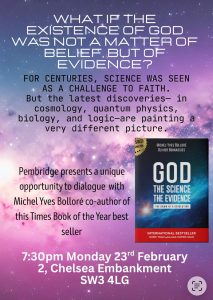
What is the scientific evidence for God? Two Frenchmen undertook to answer that question in a book which has sold over 400,000 copies in France, Spain, Italy, Japan to name a few. First published in 2021, an English translation was launched in October 2025. It was, therefore, a great privilege when co-author Michel-Yves Bolloré accepted an invitation to be one of the guest speakers in the 2026 Pembridge series of cultural talks for young professionals.

This book has taken the thinking world by storm. It was listed among The Times and Sunday Times science books of 2025.
Leading scientists
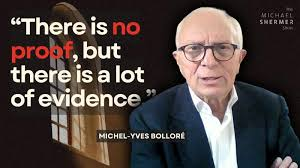
Bolloré, an engineer and entrepreneur, explains that he and his co-author Olivier Bonnassies engaged with more than 20 leading scientists to produce this work. Interestingly,many of the scientists they worked with were non-believers or agnostic. Bolloré and Bonnassie thought it would take them one year to write the book. In the end it took four. Their aim was to address the issue in an easy-to-read format, but which would be completely accurate.
The central question the authors sought to answer was: Is there a creator God or not? Nothing can come out of nothing. So for the universe to have a beginning, there must have been a creator God. The development of science over the last 100 years points to evidence that there was a beginning. Bolloré cites the scientist Robert Wilson and his colleague who discovered a crucial piece of evidence to support the Big Bang theory for the beginning of the universe. Wilson concluded that if the theory is true, then we cannot escape the question of a creator.
A department store
Why is this book resonating so strongly with people? Bolloré points to the prevalence of anxiety in families and society. 55% of people in his native France do not believe in God. He senses that there is a hunger to know more and his book explores what science and reason can say. He stresses that the book is looking at the evidence for a creator God, not for a religion. To illustrate the scope of the book, which moves the reader from hard atheism,to agnosticism to theism, he gives the example of a department store, with many floors selling a variety of goods. The lower basement is a dark carpark, the basement is still below ground and on reaching the ground floor you can ascend to many other floors. His book is the lift and, Bolloré says, it stops at the first floor. It’s then up to individuals which other floors they choose to visit.
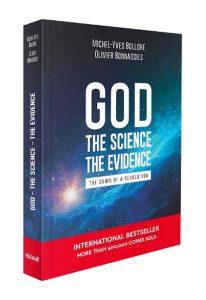

Bolloré says that he and his co-author sought to place their book at the junction between science and philosophy, between physics and metaphysics. Their work embraces history and includes chapters on the bible and miracles. It gives a full panoramic view of the evidence for a creator God.
Materialism
What can we say to those who hold a purely materialistic view of creation? Bolloré says that materialism is fast becoming an irrational belief. If there is no creator, his view is that ‘we are all mosquitos’. If materialism is true we are no more than animals and there is no good or evil. Everything is permitted.
He also dismisses the ‘God in the gaps’ idea which says that the things which science cannot answer can be attributed to God. He asserts that the new atheism movement is dead. Today, it is not possible to account for creation without a creator God.
Primordial soup
Should science and God be kept apart? Bolloré responds to this by citing the shifting trends in trying to account for the presence of life. In 1850 Darwin thought that life could arise out of hot water near a volcano, exposed to extreme weather conditions. Indeed, in the 1950s US scientists tried to create these conditions to produce what is known as primordial soup. However, the discovery of DNA shut down such experiments. Bolloré and his co-author have set out the many pieces of scientific evidence for a creator God.
Among the many plaudits this work has received, many, naturally enough, from the religious quarter, this one stands out: ‘Sometimes, when I look up at the thousands of stars shining in the night, I think about how many people have similarly looked up and wondered how this all began. I certainly don’t know the answer, but maybe some readers will have the chance to find the beginning of an answer in this book.’ Robert W. Wilson, recipient of the 1978 Nobel Prize in Science.
For those listening to Michel-Yves Bolloré, it was certainly the ‘beginning of an answer’.